How to Design Your Home So Everything Feels Easier (The “lazy” person's guide to looking like a genius)
Let’s be honest for a second. We’ve all had those mornings where it feels like the house is actively conspiring against us. You can’t find your keys, the coffee mugs are somehow all at the back of the highest shelf, and you have to perform a Cirque du Soleil maneuver just to get the vacuum out of the closet.
By 9:00 AM, you’ve already made seventeen unnecessary decisions and burned through half your mental battery. You aren't even at work yet, and you already want to resign from life.
Most people assume that "organized" people are just born with a special gene that makes them enjoy labeling spice jars. But here is the secret: Truly organized people are actually the laziest people on earth. We just realized that it’s much easier to design a home that works for us than it is to constantly fight a house that is trying to trip us.
Welcome to the heart of the Calm Home System. Today, we aren't talking about "tidying." We are talking about Environmental Design. Because the truth is: Your environment shapes your behavior. If you want to change your life, stop trying to change your willpower and start changing your floor plan.
1. Why Your Home Feels Hard: Flow vs. Friction
If you take nothing else away from this guide, remember this: Human beings are like water; we always take the path of least resistance.
In the world of home design, there are two opposing forces: Friction and Flow.
- Friction is the invisible wall between you and the thing you want to do. If your workout gear is buried under a pile of winter coats in the basement, that is high friction. Your brain will look at that "task" and decide that scrolling on your phone is a much better use of time.
- Flow is when the environment pulls you into the right action. If your gym bag is packed and sitting by the door, the friction is gone. You are in a state of flow.
Most homes are accidental obstacle courses. We store things where they "fit" or where the previous owners put them, rather than where we actually use them. To design a home where everything feels easier, we have to engineer the friction out and the flow in.
2. The Golden Rule: Placement Strategy (The "Point of Use" Law)
The biggest mistake people make is storing things by category rather than by activity.
Traditional organization says: "All the lightbulbs go in the utility closet." Environmental Design says: "The lightbulbs go in the room where the lamps are."
If you always open your mail at the kitchen island, but your shredder is in the home office upstairs, you have created a "Friction Gap." What happens to that mail? It sits on the counter for three weeks until it evolves into a sentient being.
How to Fix It: Look at your most annoying daily tasks. Where do you do them? Now, look at where the tools for those tasks are. If they aren't in the same place, you’ve found your leak. Move the shredder to the kitchen. Put the vitamins next to the coffee maker. Put the dog leash on a hook exactly where the dog starts spinning in circles.
Everything should live within arm’s reach of where the action happens.
👉 If your home constantly feels messy as well, read this:
Why Your Home Feels Messy (Even When You Clean It)
3. The "Two-Step" Rule
In the Calm Home System, we have a very strict policy: If it takes more than two steps to put something away, it will stay on the counter.
We often design our homes for how they look, not how we live. We buy beautiful nesting boxes that require you to unstack three bins, unclip a lid, and move a heavy tray just to put away a pair of scissors.
That is a "High-Touch" system. It’s unsustainable. By Wednesday, those scissors are sitting on the table because your brain simply refuses to do that much work for a pair of office supplies.
The Strategy: Design for "One-Handed" storage.
- Open Bins over Lidded Boxes: If you can drop a toy/sock/remote into a bin without opening anything, you’ll actually do it.
- Hooks over Hangers: If your kids won't hang up coats (because hangers are high-friction), put up hooks. It’s one step vs. four steps. The hook wins every time.
4. Visual Cues: Using Your Eyes to Save Your Brain
Your brain is a massive consumer of energy. Every time you have to "search" for something, you are draining your battery. A "Calm Home" uses visual cues to automate your routines.
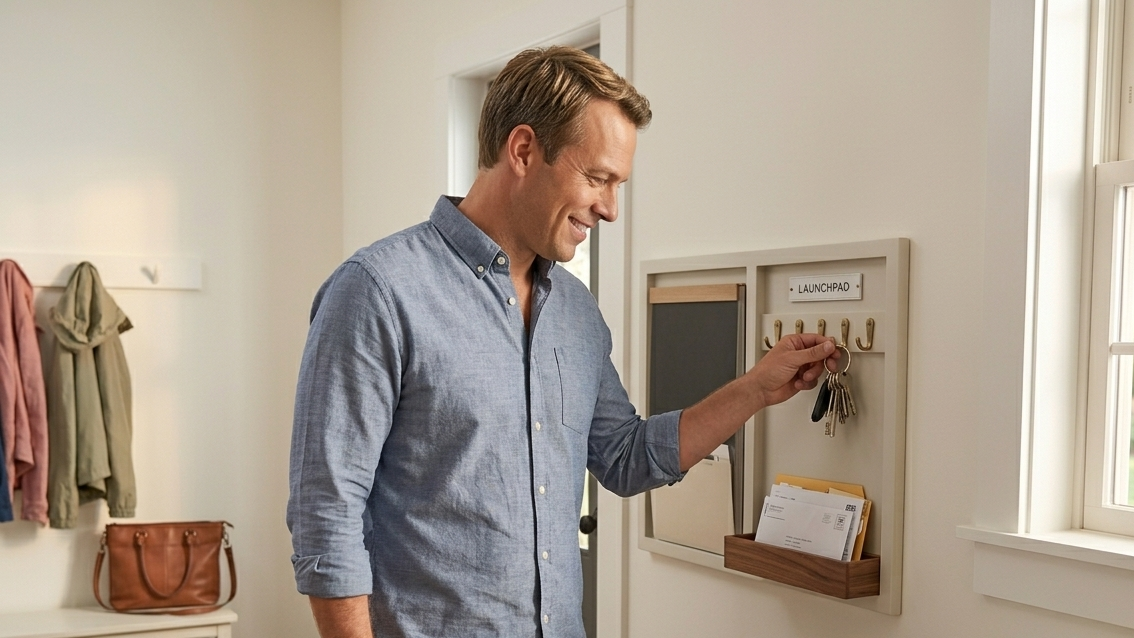
The "Launchpad" Concept: The entryway is the most high-stakes zone in your house. If you lose your keys there, the whole day is ruined. A Launchpad is a dedicated "station" that signals to your brain exactly what needs to happen.
- A tray for keys: (The "Home" for your identity).
- A dedicated spot for your bag: (Accessibility).
- A "Next Action" basket: (For things that need to leave the house).
When you have a Launchpad, you stop thinking about leaving the house. You just flow out the door. You can see how this fits into our broader 4-Layer System Framework in the Pillar Post.
5. Designing for the "Future You" (The Daily Reset)
Environment design isn't just about where you put your couch; it’s about how you leave the room for the person you will be tomorrow morning.
Think of your home as a User Interface (UI). If you wake up to a sink full of dishes and a living room covered in laundry, the "UI" of your morning is broken. You are starting your day in "Troubleshooting Mode."
The fix is the 10-Minute Daily Reset. This isn't a deep clean. It is a "resetting of the stage." You are returning the tools to their stations so that when "Future You" walks into the kitchen tomorrow, the environment says, "Everything is ready for you. Let's go." When the environment is pre-loaded for your success, your behavior follows suit without you even trying.
6. Why This Changes Your Identity
The most powerful thing about environmental design is that it changes how you see yourself.
When you live in a house full of friction, you start to believe you are "lazy," "messy," or "incapable." You feel like a victim of your own surroundings. But when you redesign the space to favor flow, you realize you were never the problem—the design was.
Your environment is a physical manifestation of your mental state. By making your home easier to live in, you make your mind easier to live in. You reclaim the energy you used to waste on "searching" and "deciding," and you can pour it into your work, your family, or—heaven forbid—actually relaxing.
Start Designing Your Flow Today
You don't need a million dollars or an interior designer to do this. You just need to start noticing where you "stumble" in your own home.
- Find one "Friction Point" today. (The drawer that sticks, the pile that grows, the keys that vanish).
- Move the tools to the action.
- Apply the Two-Step Rule.
If you want to dive deeper into the science of how your home is draining your battery (and how to stop the leaks), grab the Free Guide
Start designing a home that works for you.
This free guide helps you identify what’s creating friction in your space—and how to make everyday life feel simpler and more natural.
Most people try to fix their home with more effort.This guide shows you how to fix it with the right structure instead.
FAQ: The Design for Ease Reality Check
1. Does this mean I can't have "pretty" things?
Not at all! You just shouldn't have "pretty" things that make your life "ugly." If a beautiful bowl on your entryway table becomes a junk drawer for old batteries and loose change, it’s not beautiful anymore—it’s a friction point. Choose aesthetics that support your flow.
2. How do I know if I have too much friction?
Ask yourself: "Do I avoid doing this task because of the setup or the cleanup?" If the answer is yes, you have a friction problem. For example, if you don't use your blender because it’s stored behind the toaster and under a heavy lid, that’s design friction.
3. What is the most important room to "Design for Ease" first?
The Entryway. It is the "transition zone" between the chaos of the world and the peace of your home. If you get the entry right, you set the tone for the entire evening. If you get it wrong, the stress of the outside world follows you all the way to the bedroom.
4. Is this just for people who live alone?
Actually, it’s essential for families. You cannot control other people's behavior, but you can control the environment they live in. If you want your kids to put their shoes away, don't nag them—put the shoe bin exactly where they naturally kick their shoes off. The environment will nag them for you.