The Calm Home System: The Definitive Guide to Organizing Your Life for Clarity, Energy, and Flow
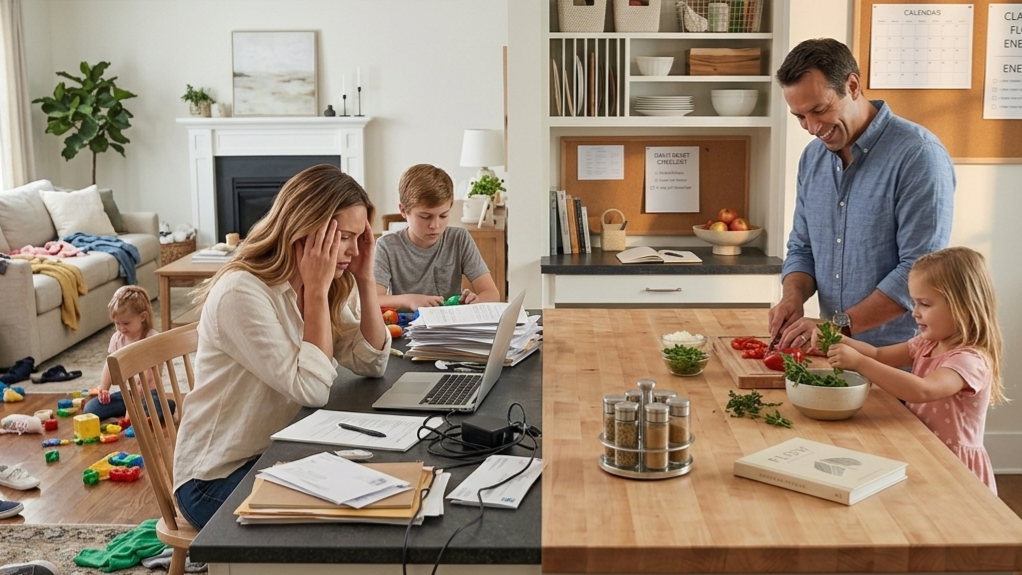
Your home looks fine. But it doesn’t feel right. You clean. You organize. And a few days later… it’s back.
Not because you're lazy—but because your home isn’t built as a system.
Most people try to fix their lives with better habits.
But your environment is the foundation everything else sits on.
If your space creates friction, your energy drains.
If your space supports you, everything becomes easier.
This is The Calm Home System™—a structured way to turn your home into a place that gives you clarity, energy, and flow.
Feel stuck in chaos, no matter how hard you try?
Start building real stability step-by-step
This is part of the Intentional Living System → You can also read
Energy Is Everything: How to Restore Your Energy and Take Back Control of Your Life
The Stability Ladder™ : A Simple Way to Build a Better Life
The Great Misconception: Why Traditional Organization Fails
If you’ve ever felt like a failure because your home won’t stay tidy, it is time to stop blaming your personality and start blaming your methods. Traditional "organizing" fails for three fundamental reasons:
Cleaning is an Event, Not a Solution
Cleaning is about hygiene. It deals with the surface level—dust, dirt, and grime. While necessary, a clean house can still be a fundamentally disorganized and stressful place to live. You can have sparkling floors and still spend twenty minutes every morning looking for your car keys. Cleaning is a temporary state; a system is a permanent structure.
Decluttering is Reactive
The "just throw it away" philosophy, popularized by many minimalism movements, is a temporary fix. As we explored in our deep dive, Why Clutter Is Not the Real Problem, clutter is merely a symptom. It is the physical manifestation of a decision you haven't made or a task you haven't started. If you don't change the decision-making process, the clutter will always return to fill the vacuum you created.
The Myth of the "Organized Person"
We often treat organization as an innate personality trait. We say, "I'm just not an organized person." This is false. Organization is a Standard Operating Procedure. It is a set of rules that makes the right action the automatic action. You don't need a new personality; you need a better blueprint.
The Core Principle: Friction vs. Flow
To master your home, you must understand the physics of human behavior. Every object, every drawer, and every room in your house is either creating Friction or facilitating Flow.
The Heavy Weight of Friction
Friction is the "invisible brake" on your productivity and your peace of mind. It is the micro-frustration that occurs when a task requires more physical or mental effort than it should.
- Physical Friction: Having to move a heavy vacuum to get to the broom.
- Cognitive Friction: Not knowing where your tax documents are kept, forcing you to think before you act.
- Visual Friction: A desk covered in random papers that "shout" for your attention every time you walk by.
Friction leads to procrastination. If it’s hard to start a task, your brain will find a reason to avoid it.
The Ease of Flow
Flow is the state where your environment pulls you toward the right action. In a high-flow home, the tools you need are exactly where you use them. You move through your routines without "thinking" about the logistics. We see the power of this most clearly in the kitchen. When you Organize Your Kitchen for Better Habits, you find that healthy cooking becomes the path of least resistance because the friction has been engineered out of the room.
👉 Want a simple way to fix your home without overthinking it?
A Simple Home Upgrade Guide: Practical changes that make your home calmer, more organized, and easier to live in.
The 4-Layer Calm Home Framework
This is the core of the system. Instead of random tidying, we build your home’s "Operating System" through these four specific layers.
Layer 1: Clarity (The Mental Map)
Every space, surface, and drawer in your home must have a singular, non-negotiable purpose.
- The Problem: "Maybe" spaces. The dining table that is also an office, a craft station, and a landing pad for the mail. When a space is ambiguous, your brain doesn't know which "mode" to enter.
- The Fix: Assign a mission to every zone. If a surface is for eating, nothing else lives there. When a space has clarity, your brain enters the correct "mode" (Rest, Work, or Play) the moment you walk in.
Layer 2: Accessibility (The Proximity Rule)
Items should live at the point of use. * The Logic: If you always open mail at the kitchen island, that is where your shredder and recycling bin should live.
- The Result: You eliminate the "transition time" where clutter usually settles. By making the "right" action the "easiest" action, you bypass the need for willpower entirely. This is how we Reduce Decision Fatigue at Home.
Layer 3: Simplicity (The Inventory Cap)
Your "stuff" must never exceed the capacity of your "system."
- The Reality: Most homes are "over-leveraged." We have more items than we have the time, space, or energy to manage.
- The Fix: We don't aim for minimalism for the sake of an aesthetic; we aim for simplicity to reduce the mental load. Fewer choices lead to more energy.
Layer 4: Flow (The Sequence of Life)
Flow is how you move through the system. It’s the routines that keep the first three layers alive.
- The Tools: This includes "Launchpads" for leaving the house and the 10-Minute Daily Reset to return the house to its baseline every night. Flow is what makes a home "self-healing."
Why This Changes Everything: The Psychological Shift
When you move from "cleaning" to "systems," the transformation isn't just physical—it's neurological.
Ending Decision Fatigue
Every misplaced item is a decision waiting to be made. Where is it? Where should I put it? Do I need this? By the time you get to your actual work, you’ve already drained your mental battery on domestic logistics. The Calm Home System automates these choices, saving your "decision currency" for the things that actually matter.
Lowering Cortisol
Visual clutter is a constant stress signal. It tells your brain "there is work to be done." By creating a Calm Home, you allow your nervous system to exit "Fight or Flight" mode and enter "Rest and Digest" mode. You are finally able to recover in your own home.
Creating Habit Consistency
Habits are 10% willpower and 90% environment. If you want to work out, lay your clothes out (Accessibility). If you want to eat well, prep your kitchen (Flow). The system makes consistency inevitable because it removes the choice to fail.
Implementation: How to Build Your System
You don't need a week-long sabbatical to implement this. You need a series of "Micro-Wins" that compound over time.
- Identify the Friction: Walk through your home with a notebook. Where do you always lose your keys? Where does mail pile up? Where do you feel a "dip" in your energy?
- Define the Zones: Pick one room and define the Clarity of each surface. "This desk is for deep work only." "This counter is for food prep only."
- Audit Accessibility: Move the tools of your life to where you actually use them. Put the trash can where the trash naturally accumulates, not where the architect thought it should go.
- Install the Reset: Commit to the 10-Minute Daily Reset. Before bed, return the house to its functional baseline so you can wake up to Flow, not Friction.
Before: You walk into your kitchen and hesitate. You don’t know where things go.
After: You move automatically. Everything has a place. Cooking becomes simple, not stressful.
The Missing Piece in Your Life Architecture
You don’t have a cleaning problem. You have a system problem.
If your home keeps falling back into chaos, it’s not because you’re lazy —
it’s because your environment isn’t designed to support you.
You don't rise to the level of your goals. You fall to the level of your environment. Stop fighting your house. Stop blaming your discipline. Build a system that works for you —
so you can focus on the life you actually want to live.
Start Fixing Your Home Today — Get the Free Guide
Build the Full System
Ready to redesign your life from the ground up — not just organize it? Join our flagship program where we walk you through every room, every layer, and every routine to turn your home into a sanctuary of flow.
If you want a complete system to:
- Reduce overwhelm
- Create structure
- Build a calm, stable life
👉 Explore the full system here: The Intentional Living System
FAQ
1. How is this different from just being a minimalist?
Minimalism focuses on the quantity of items you own. The Calm Home System focuses on the utility and flow of those items. You can own a lot of things and still have a calm home, provided they all have a designated "home" (Clarity) and are easy to reach (Accessibility). We aren't trying to empty your house; we are trying to optimize your energy.
2. I live with kids and a partner who aren't "organized." Will this still work?
Yes. In fact, systems are most necessary when you live with others. We design for the "least organized" person. If someone keeps leaving their coat on the chair, it’s usually because the coat closet is high-friction (too far away or too crowded). By moving a hook to where they naturally drop the coat (Accessibility), the person "becomes" organized because the system makes it the easiest option.
3. Does this require a lot of expensive containers and bins?
Absolutely not. Buying containers before you have a system is actually a "Home Organization Mistake." Containers are part of Layer 3 (Simplicity), but you cannot simplify what you haven't first clarified. Most of our students find they actually need fewer storage products once they implement the 4-layer framework.
4. How do I maintain the system once it’s set up?
Maintenance is built into Layer 4: Flow. The 10-Minute Daily Reset is the "self-healing" mechanism of the house. Because the system is designed around your natural habits, maintenance takes minutes, not hours. You aren't "cleaning up"; you are simply returning items to their homes.
5. Which room should I start with?
We recommend starting with the Entryway (The Launchpad) or the Kitchen (The Fuel Station). These are high-impact zones. When you fix the entryway, your day starts with Flow. When you fix the kitchen, your body is fueled with better energy. These wins provide the momentum to tackle the rest of the house.