Why Clutter Is Not the Real Problem (And What Actually Is)
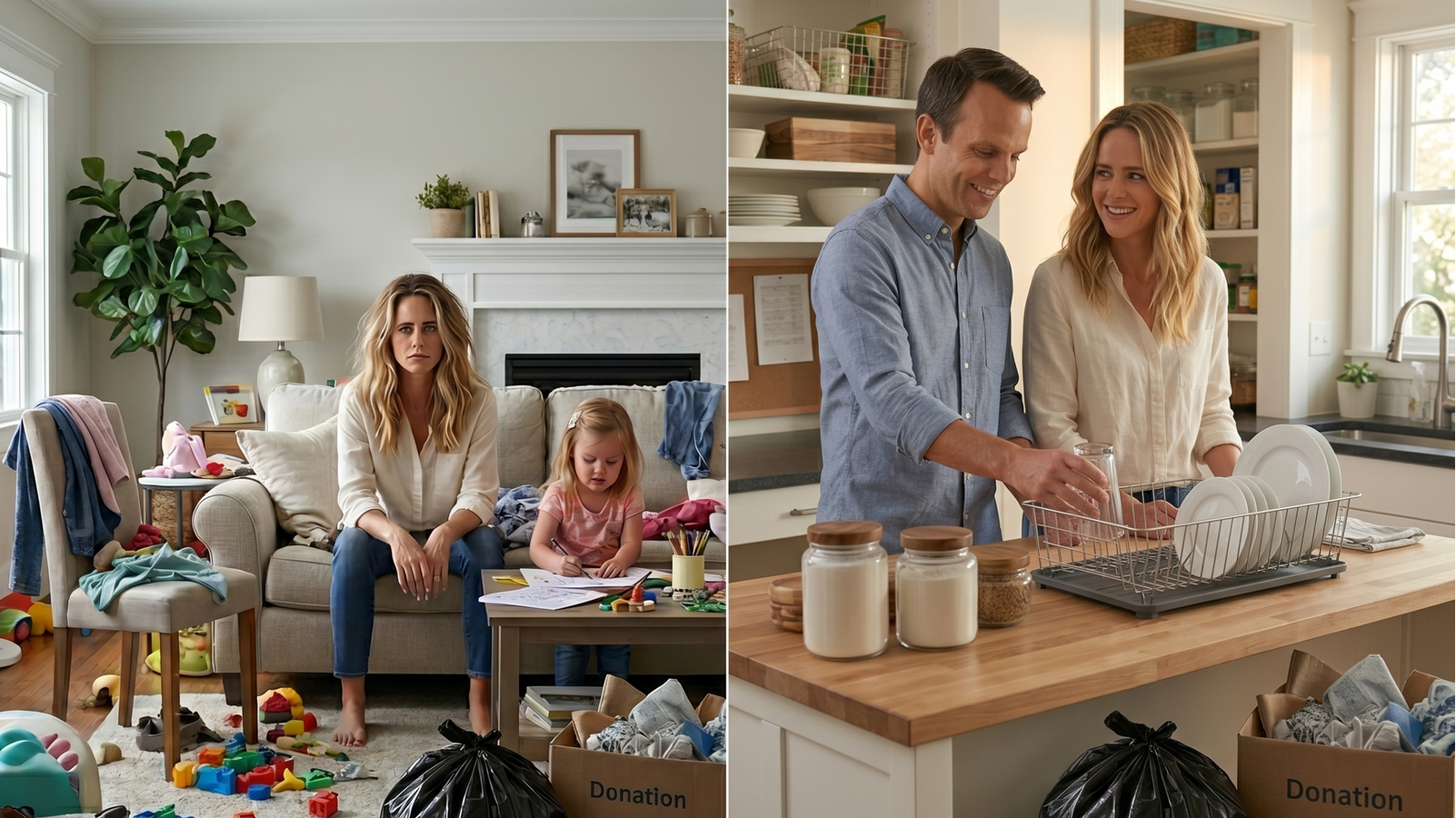
You’ve done it before. You’ve spent a three-day weekend "purging." You bought the trash bags, you filled the donation bins, and you finally cleared the dining room table. For 48 hours, you felt a sense of relief.
But then, the "creep" started. A rogue stack of mail here. A stray pair of shoes there. Within two weeks, the clutter returned like a tide that refuses to stay out.
Most home organization experts will tell you that the solution is to "just declutter more." They’ll tell you to ask if an item "sparks joy" or to follow a 30-day minimalism challenge. But if decluttering were the ultimate solution, you wouldn't have to keep doing it.
The truth is: Clutter is not the problem. Clutter is merely a symptom. If you keep treating the symptom without addressing the underlying cause, you are trapped in a cycle of temporary fixes.
That’s when it starts to feel like no matter what you do… nothing sticks.
The Myth: "I Just Have Too Much Stuff"
The most common home organization mistakes stem from the belief that volume is the enemy. We think, "If I just had fewer things, my life would be organized." While reducing your inventory helps, decluttering doesn’t work as a standalone strategy because it doesn't change the behavioral physics of your home. You can throw away half your belongings today, but if your remaining items don't have a functional "flow," the chaos will simply redistribute itself to fill the gaps.
When you focus only on decluttering, you are playing defense. You are reacting to the mess. To stop the cycle, you have to play offense. You have to stop asking "How do I get rid of this?" and start asking "Why did this pile up here in the first place?"
The Reality: Clutter is a Symptom of System Failure
Why clutter keeps coming back is simple: Your environment lacks an operating system. Clutter is simply "unplaced energy." It is the physical manifestation of a decision you haven't made or a system that is too difficult to follow.
There are two real problems at the heart of every messy home:
1. The Lack of Structure
Most homes are organized by category (e.g., "This is the drawer for office supplies") rather than by action (e.g., "This is the station where I process mail and pay bills"). When structure is based on categories alone, items often end up in "purgatory"—those flat surfaces where things sit because they don't quite fit the vague categories you've created.
2. The Friction Gap
If it takes more than two steps to put an item away, you won't do it. If your vacuum is behind three heavy boxes, you won't vacuum. If your filing cabinet is in the basement but you open mail in the kitchen, the mail will stay on the kitchen counter. This is "Friction." Clutter accumulates in the gap between where an item is used and where it is "stored."
This is exactly why your environment affects your energy.
If you want to understand this deeper, read:
Why Energy Is the Foundation of a Stable Life
The Calm Home Solution: Beyond Decluttering
In the Calm Home System, we don't start with a trash bag. We start with a blueprint. We move through four specific layers to ensure that once the clutter is gone, it stays gone.
Layer 1: Clarity (Define the Purpose)
Before you throw anything away, you must define what every room—and every surface—is for. If a surface doesn't have a clear purpose, it defaults to being a "catch-all." When you give a space a mission (e.g., "This table is only for eating and connection"), the clutter suddenly feels like an intruder rather than a resident.
Layer 2: Accessibility (Reduce the Steps)
We design the home so that the "right" action is the easiest one. We place items at the point of use. If you always take your vitamins in the kitchen, they shouldn't be in the bathroom cabinet. By aligning accessibility with your natural habits, you eliminate the friction that creates clutter.
Layer 3: Simplicity (Manage the Inventory)
Only after the structure is set do we look at the volume. Simplicity is about ensuring your "stuff" does not exceed the capacity of your "system." We don't aim for minimalism for the sake of aesthetics; we aim for simplicity to reduce Decision Fatigue.
Layer 4: Flow (Automate the Movement)
The final layer is about how energy moves through the house. We create "Launchpads" for leaving and "Landing Zones" for arriving. We establish The 10-Minute Reset to return the house to its baseline. Flow is the insurance policy that keeps the clutter from ever returning.
Feeling this already in your home?
👉 Start simple:
Download A Simple Free Home Upgrade Guide
Practical changes that reduce friction and create flow.
Stop Cleaning. Start Designing.
👉 Cleaning is reactive - Cleaning fights the mess.
👉 Design is proactive - Design prevents it.
You don’t need more trash bags..You need a better system.
You don't rise to the level of your decluttering goals; you fall to the level of your home systems. When you fix the system, the clutter disappears as a natural byproduct. You stop being a "cleaner" of your home and start being the architect of your life.
Build a System That Actually Lasts
This is the fundamental shift that differentiates a "tidy" house from a "Calm Home." One is a temporary state of effort; the other is a permanent state of ease.
Ready to move past the myth of decluttering and build a framework that supports your energy, clarity, and focus?
Reclaim Your Energy Through Your Environment
Most people try to fix their habits.
But habits follow structure—not the other way around.
If you want a simple way to start:
“A Simple Home Upgrade Guide”
Practical changes that make your home calmer, more organized, and easier to live in.
Read the Full Pillar Post: The Calm Home System: How to Organize Your Home for Clarity, Energy, and Flow]
Frequently Asked Questions
1. Does this mean I should stop decluttering entirely?
Not at all. Removing items you don't use is helpful, but it's only 20% of the battle. The other 80% is creating the Accessibility and Structure that prevent new items from becoming "clutter" the moment they enter your door.
2. How do I identify my "Friction Gaps"?
Look for the places where piles naturally form. That pile of shoes by the door? That’s a friction gap. It means your current shoe storage is likely too far away or too difficult to use. Instead of fighting the pile, move the storage to the pile.
3. What is the very first step to changing my home's "Operating System"?
Start with Clarity. Pick one flat surface in your home that is currently a mess. Don't just clean it—assign it a strict purpose. Tell yourself, "This surface is ONLY for [Task]." You will be amazed at how much easier it is to keep it clear once it has a job to do.