FAQ: Climbing the Ladder in Real Life
1. "Can I work on multiple levels at once, or is that a recipe for disaster?"
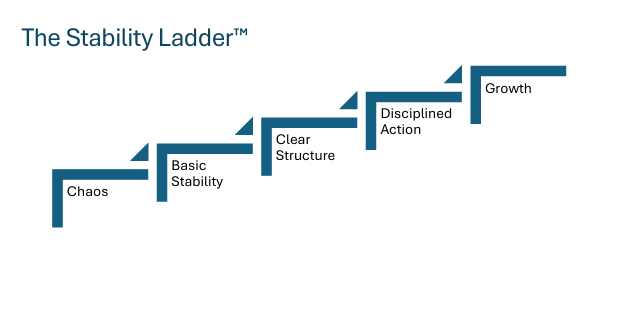
Technically, your life is always happening across all levels, but your emotional and strategic focus must remain on your lowest rung. Think of it like a house with a leaky basement: you can certainly pick out new curtains for the attic (Level 4: Growth), but if the basement is flooding (Level 1: Energy), those curtains will eventually smell like mold. If you find yourself "relapsing" into chaos, it’s usually because you tried to build a Level 3 system on Level 1 energy. Secure the base first; the rest of the climb becomes significantly lighter.
2. "What if my partner or kids are at 'Level 0' but I’m trying to reach 'Level 3'?"
This is the most common hurdle for parents. You cannot "force-climb" someone else up the ladder, but you can stabilize the environment for them. In the Stability Ladder™ framework, we focus on environmental design over behavioral control. Instead of nagging a partner to be more organized, you create Level 3 "drop zones" that make it easier for them to be organized than to be messy. Often, when the "anchor" person in the house stabilizes their own rungs, the lowering of the household's total Allostatic Load (stress) naturally helps the rest of the family move up a rung without a single argument.
3. "Is 'Stability' just a fancy word for being boring and rigid?"
There is a cultural myth that "spontaneity" requires chaos. In reality, chaos is the enemy of true freedom. When you are at Level 0, you aren't being spontaneous; you are being reactive. You aren't "going with the flow"; you are being "swept away by the flood." True spontaneity—the kind where you can decide on a whim to take the kids to the park or start a new creative project—is only possible when your Level 2 and 3 systems are running on autopilot. Stability creates the margin for magic.
4. "I’ve reached Level 3 before, but I always fall back to Level 0. Why can't I stay there?"
This usually happens because of "Implementation Debt." If you build a system that is too complex for your natural energy levels (like a color-coded filing system that takes 30 minutes to maintain), it will collapse the moment you get a cold or have a busy week at work. The goal of The Stability Ladder™ isn't to build the perfect system; it’s to build the sturdiest one. If you keep falling, it’s a sign that your Level 3 systems are too "heavy." Strip them down to the bare minimum until they feel effortless even on your worst day.
5. "How do I know when I’m actually ready for 'Level 4: Growth'?"
The signal for Level 4 isn't a burst of "motivation"—it is a sense of quiet capacity. You know you are ready to climb to the top when your daily life feels "boring" in a healthy way. When the laundry is done, the kitchen island is clear, and you have 30 minutes of quiet in the evening where you aren't "putting out fires," that is your CEO brain signaling that it has a surplus of energy. That surplus is your "Growth Capital." Use it wisely to invest in new skills or hobbies, rather than just filling the space with more "busy work."