The 5 Things in Your Home That Are Quietly Draining Your Energy
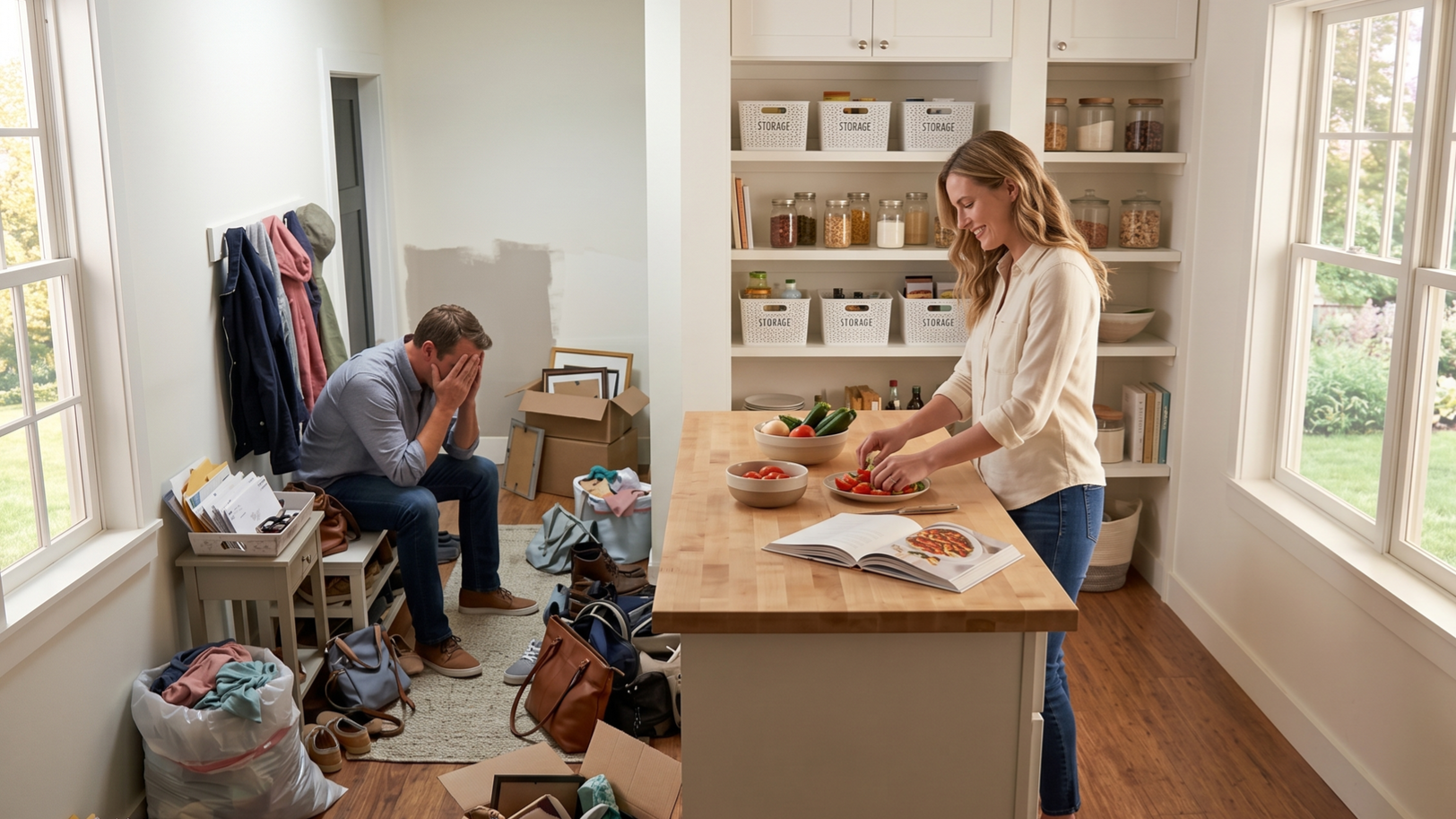
Most people assume tiredness comes from what happened during the day.
The work, the commute, the children, the decisions. The things that were obviously demanding.
And those things matter. But there's another layer underneath them — one that's harder to see because it never announces itself. It's the environment you come home to. The spaces you move through every day. The things that cost a little energy each time, invisibly, without ever feeling significant enough to address.
These are the quiet drains. Small individually. Together, they account for more of the daily depletion than most people realise.
Here are the five most common ones — and what to do about each.
The Hidden Energy Leaks That Drain Your Life (And How to Fix Them)
1. Visual clutter
A cluttered surface doesn't just look untidy. It creates a low-level demand on attention that runs constantly in the background.
Your brain registers every unresolved item in its field of view — the pile of post, the things that haven't been put away, the surfaces that have gradually accumulated whatever had nowhere else to go. Each one is a small open question. Together they create a background hum that makes it harder to settle, harder to rest, and harder to focus on whatever you're actually trying to do.
This is why walking into a clear kitchen feels different from walking into a cluttered one — even before you've consciously registered anything. The environment is already communicating with your nervous system.
The fix
Start with one surface. The one you see most often — the kitchen counter, the table by the door, the desk. Clear it completely each evening as part of the reset. Not deep cleaned. Just cleared.
That one surface sets the tone for the whole space. And the effect on how the next morning starts is immediate.
2. Unclear homes for things
Every time you pick something up and have to think about where it goes, that's a small decision. Every time you search for something that doesn't have a fixed place, that's another one.
These feel trivial. But they happen dozens of times across a day — the keys that could be in three possible places, the scissors that migrate, the charger that's never where you last left it. Each one is a minor interruption and a minor drain. Over a full day they add up to something significant.
A home without clear, permanent places for frequently used things is a home that generates unnecessary decisions constantly. Not because of any one missing item, but because the system doesn't make the decision for you.
The fix
Pick the five things you search for most often. Give each one a single, specific permanent home — not a general area, a specific spot. Then make it a non-negotiable that they go back there every time.
The point isn't tidiness. It's removing the decision entirely. You stop thinking about where it goes because that's already been decided.
3. High-friction layouts
Friction is anything that makes a routine action harder than it needs to be. The vacuum that's difficult to get out. The coffee things spread across three different cupboards. The bag that has to be assembled from scratch every morning.
None of these feel like problems. They're just slightly inconvenient. But slightly inconvenient, repeated daily, creates resistance. And resistance — even mild, habitual resistance — costs energy before you've even started the thing you were trying to do.
High-friction homes make good routines harder to maintain, not because the routines are wrong, but because the environment makes them unnecessarily effortful.
The fix
Look at your most repeated daily routines — the morning start, the evening reset, the things you do every single day. Then ask: what are the friction points? What requires extra steps, extra searching, extra effort?
Move things closer to where they're used. Make the most frequent actions the easiest ones. The goal is that the right thing requires the least resistance — so you do it naturally, without having to push through anything.
4. Unfinished things
Most homes have at least one — the project that's been half-done for months, the thing that needs fixing, the space that's been in a temporary state for longer than intended.
These sit in the background. You don't think about them consciously most of the time. But they register. Every time you pass the unfinished corner or notice the thing that still hasn't been dealt with, there's a small cost — a brief reminder of something unresolved.
Unfinished things keep a quiet loop running in the mind. Not loudly. Just persistently. And persistent background processing uses energy even when you're not aware of it.
The fix
Make a list of the unfinished things in your home. For each one, make a decision: when will this be done, or is it not going to happen?
If it's going to be done — put a date on it. Even a rough one. A decision made is a loop closed.
If it's not going to happen — let it go. Remove the project or the item. The relief of closing that loop is immediate and real.
The goal isn't a perfect home. It's a home that doesn't have things quietly demanding attention they're never going to get.
Why Your Kitchen Is the Hardest Room to Reset (And the Simplest Place to Start)
5. Lighting that works against you
Light is one of the simplest and most overlooked aspects of how a home feels — and how it affects energy.
Harsh overhead lighting in the evening keeps the body alert when it should be winding down. Dark spaces during the day make it harder to feel focused or awake. The wrong light at the wrong time quietly works against what you're trying to do — rest, focus, transition between the two.
Most homes rely on a single overhead light for every hour of the day. That's a blunt tool for something that matters more than it seems.
The fix
Two changes make the biggest difference.
During the day, maximise natural light where possible. Open blinds fully, keep windows clear. Natural light improves mood and focus in ways that artificial light doesn't replicate.
In the evening, switch from overhead lights to lamps. Warm-toned bulbs at eye level or below. This signals to the body that the day is ending — which makes it easier to actually rest when you get there.
You don't need smart lighting or a renovation. A couple of lamps with warm bulbs in the spaces where you spend your evenings is enough to make a real difference.
The 10-Minute Evening Reset: Why Small and Daily Beats Big and Occasional
Why these five things matter together
None of these drains is dramatic on its own. That's what makes them hard to notice and easy to dismiss.
But they operate simultaneously, across every hour you spend at home. Visual clutter running in the background. Decisions about where things go repeating throughout the day. Friction in the routines that should be automatic. Unfinished loops quietly demanding attention. Light that works against rest.
Together, they make a home that costs more to live in than it gives back. And that cost shows up in how you feel by evening — not because of what the day demanded, but because the environment added its own quiet tax on top of it.
Fix one. Then another. The home doesn't need to be perfect — it needs to stop working against you.
The full system
These five fixes are part of a larger approach to building a home that supports your energy rather than draining it. The Calm Home System covers all of it — the structure, the daily resets, and the room-by-room changes that make the biggest difference.
Start with the reset
The Home Reset Guide walks you through stabilising the three spaces that generate the most daily energy drain — in one evening, without overhauling everything at once.