The 10-Minute Daily Reset That Keeps Your Home Organized
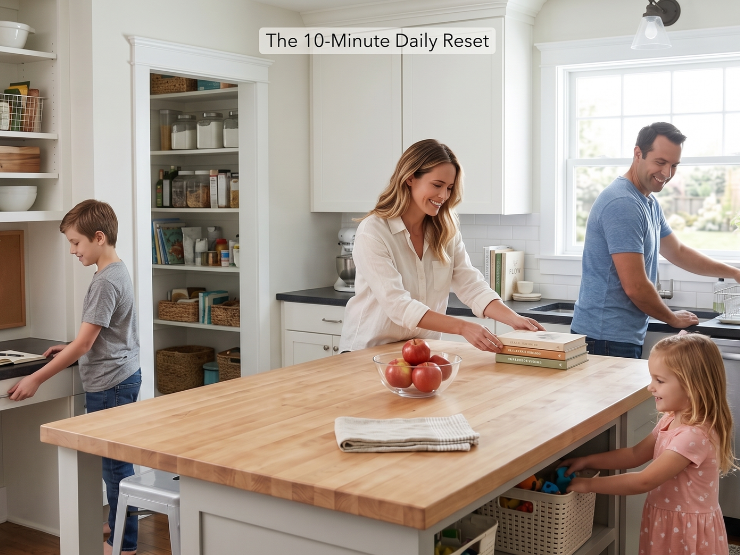
We’ve all been there. You spend an entire Saturday—six hours of grueling labor—decluttering the kitchen, scrubbing the baseboards, and finally organizing that "doom pile" in the corner of the living room. You stand back, admire the sparkling surfaces, and feel a momentary sense of peace.
Then, Monday happens. By Tuesday evening, the mail has migrated back to the counter. By Wednesday, the "doom pile" has a new neighbor. By Friday, the house looks exactly like it did before your marathon cleaning session.
Most people assume the problem is a lack of discipline. They tell themselves, "I’m just a messy person," or "I need more time to clean."
But here is the hard truth: You don’t need more time. You need a better system. A home doesn't get messy because you are lazy; it gets messy because it lacks a Daily Reset. In the world of the Calm Home System, we don't believe in marathon cleaning. We believe in high-frequency, low-effort maintenance that keeps your home at a "baseline" of order.
The Problem: Why "Organizing" Never Sticks
The reason most organizational efforts fail is that they are treated as an event rather than a process.
Think of your home like a professional kitchen. A chef doesn’t wait until the end of a 12-hour shift to clean every station; they "clean as they go" and perform a "reset" between services. If they didn't, the kitchen would become a hazardous, non-functional mess within hours.
Your home is no different. Life creates "entropy"—a natural slide toward disorder. Every time you cook, work, or play, you are creating friction. Without a daily routine to counteract that entropy, the friction builds up until the task of cleaning feels so overwhelming that you simply stop trying.
This is where the 10-minute daily cleaning routine comes in. It isn't about deep cleaning or perfection; it is about returning the home to its functional baseline.
Introducing the "Reset" Concept
A "Reset" is fundamentally different from "Cleaning."
- Cleaning is about removing dirt, dust, and grime.
- Resetting is about removing friction and restoring order.
The Goal of a Daily Reset is to ensure that when you wake up tomorrow morning, you aren't starting your day by "paying off the debt" of yesterday. When you walk into a kitchen with a clean counter and an empty sink, you have the mental space to start your day with intention. When you walk into a kitchen full of last night's dishes, you start your day in a Reactive State, already behind before you've even had breakfast.
The Step-by-Step 10-Minute Routine
To make this work, you have to be ruthless with the clock. Set a timer for 10 minutes. This prevents the "reset" from spiraling into a two-hour deep dive into a junk drawer. Here is how to keep your home organized daily using the three-part Reset.
Phase 1: Reset All Flat Surfaces (3 Minutes)
Flat surfaces—counters, dining tables, desks, and coffee tables—are "clutter magnets." Because they are horizontal, our brains view them as landing strips for anything we don’t want to deal with immediately.
- The Action: Clear the surfaces. Don't worry about deep-cleaning the drawers yet; just get the "visual noise" off the tops.
- The Rule: If it doesn't belong on that surface, it moves. Dirty dishes go to the dishwasher; mail goes to the "Capture Bin"; toys go to the toy box.
- The Result: Closing the "visual open loops" that cause subconscious stress.
Phase 2: The "Return to Home" Sweep (4 Minutes)
In a Calm Home, every object has a permanent address. During this phase, you are simply playing the role of a delivery driver, returning items to their proper homes.
- The Action: Grab a basket or just use your hands. Walk through the main living areas and pick up anything that is "out of place."
- The Rule: Don't get distracted by the items. Just drop them where they belong. If you find something that doesn't have a home, put it in a temporary "To-Be-Homed" bin (but don't let that bin become the new doom pile!).
- The Result: You eliminate the "Decision Fatigue" of having to wonder where things are the next morning.
Phase 3: Prepare for Tomorrow (3 Minutes)
The final stage is about Pre-Loading your Flow. You are looking 12 hours into the future and asking: "What will 'Future Me' need to be successful?"
- The Action: 1. The Launchpad Check: Ensure your keys, wallet, and bag are in their designated spot.
2. The Dishwasher: Start it or empty it.
3. The Visual Prize: Choose one spot (like the coffee station or your desk) and make it look "magazine perfect." It only takes 30 seconds, but it provides a massive psychological win when you see it first thing in the morning.
Why It Works: System > Motivation
The reason a 10-minute cleaning routine is more effective than a 5-hour weekend scrub is based on the psychology of Habit Formation and Cognitive Load.
1. It Lowers the Barrier to Entry
When we think about "cleaning the house," our brain perceives a massive, energy-draining task. We procrastinate because the "cost" of starting is too high. But anyone can do 10 minutes. By keeping the time commitment low, you bypass your brain's internal resistance.
2. It Leverages the Power of "Standard Operating Procedures"
Success in any area of life comes from the quality of your systems. By doing the same 10-minute reset every night, it becomes a "Standard Operating Procedure." Eventually, you stop "deciding" to do it; you just do it. It becomes as automatic as brushing your teeth.
3. It Prevents "Clutter Blindness"
When you live with a mess for a week, you stop seeing it. Your brain eventually incorporates the clutter into the "background" of your life, but you still pay the psychological tax of the stress it causes. A daily reset keeps your eyes "fresh," allowing you to catch the mess before it becomes a permanent resident.
The Ripple Effect of a Reset
When you master the 10-minute reset, you’ll notice something strange: your entire life starts to feel more structured.
Because you aren't spending your morning looking for keys or clearing a space to make breakfast, you have more "Executive Function" left for your work. You are calmer with your family. You feel more in control of your time.
This is the core promise of the Calm Home System: We don't organize just to have a pretty house; we organize to have a high-capacity life.
You don’t need more discipline—you need a system that works even when you’re tired.
If your home is a mess, stop beating yourself up. You aren't a "messy person"—you are just a person currently operating in a "high-friction" system.
The 10-minute reset is the first step in reclaiming your space and your energy. It is the small, daily hinge that swings a very large door. But remember, the reset only works if your items have a "home" to return to and your rooms have a "clear purpose."
The Daily Reset is just one component of a larger framework designed to eliminate friction and create effortless flow in your life.
To build the foundation that makes this 10-minute routine actually work, you need the full blueprint.
If your home resets itself every day, you don’t need to constantly start over—you simply continue forward.
Frequently Asked Questions
1. How do I start the Calm Home System if my entire house is already overwhelmed?
The biggest mistake is trying to do everything at once. This leads to "burnout cleaning," where you quit halfway through. Instead, start with Layer 1: Clarity. Choose just one "Zone"—even if it’s just a single kitchen drawer or your bedside table—and define its purpose. Once that small space is optimized for flow, the mental "win" will give you the energy to tackle the next zone. Remember: you aren’t cleaning; you are building a system, one piece at a time.
2. Why doesn’t organizing my home last?
Systems should be designed for the least organized person in the house. If your family leaves shoes in the hallway, it’s usually because the "home" for shoes is too high-friction (like a closet door that’s hard to open). Apply Layer 2: Accessibility. Move the shoe rack to exactly where they naturally drop their shoes. When you make the "right" action the "easiest" action, you’ll find that people follow the system without you having to nag them.
3. Do I need a full cleaning routine for this to work?
Not at all. A Calm Home isn't about how much you own; it’s about how much friction your items create. You can own a lot of things, provided every single one has a designated home and doesn't interfere with your daily flow. The goal is to reduce Visual Noise and Decision Fatigue. If an item supports your energy and focus, it belongs in your system. If it’s just "maybe" clutter that you have to move out of the way to get to what you actually need, it's a leak that needs to be plugged.
👉 Read the Pillar Post: The Calm Home System: How to Organize Your Home for Clarity, Energy, and Flow]